Queen MOM Sign Machine Embroidery
First Impression: Elegant, Warm, and Instantly Recognizable
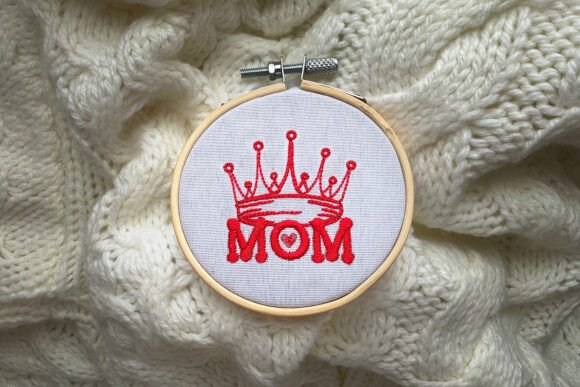
As an embroidery designer who’s prepped over 200 craft fair booths—and shipped thousands of finished products—I opened the Queen MOM Sign Machine Embroidery file expecting charm. What I got was something sharper: confident elegance with quiet warmth. The pairing of a “beautifully crafted crown” and clean, legible “MOM” lands somewhere between modern heirloom and heartfelt celebration—not cutesy, not stiff, not ironic. It reads as premium at a glance, which is critical when shoppers spend under three seconds deciding whether to pause at your booth.
Where This Design Truly Shines in Real-World Craft Fair Products
The Queen MOM Sign Machine Embroidery isn’t just versatile—it’s *strategic*. On a natural linen tote bag? It anchors the front panel without overwhelming. On a cotton apron? Centered above the pocket, it becomes a conversation starter—mothers point, daughters smile, grandmas nod. For tea towel embroidery, the crown’s silhouette holds up beautifully against textured terry or waffle weave, especially when stitched with high-contrast thread colors like navy on cream or burgundy on oat.
It also excels where many Mother S Day designs falter: as an embroidered patch. Cut, fused, and sewn onto denim jackets or canvas market bags, the design retains clarity and intention. As a pillow cover focal point (centered on 16”–18” square), it feels giftable, intentional, and boutique-worthy—not mass-produced. And for Etsy sellers? This machine embroidery design photographs exceptionally well: crisp lines, balanced negative space, and strong visual hierarchy make printable mockups pop without heavy editing.
What Makes It Sell—Beyond Sentiment
Let’s be real: people don’t buy “MOM” because it’s generic. They buy it because it feels *true*. The Queen MOM Sign Machine Embroidery works because the crown isn’t cartoonish—it’s refined, slightly asymmetrical, and dimensional enough to suggest hand-drawn care. That subtlety signals handmade quality, even when stitched by machine. Customers associate that nuance with small shop product integrity, not digital template fatigue.
In booth display terms, this design strengthens your visual rhythm. Group three items—a tea towel, a pouch, and a cap—with consistent thread palette (e.g., charcoal gray crown + soft black “MOM”) and you’ve built instant brand consistency. No need for banners or signage: the design itself communicates tone, audience, and value.
Production Practicality: Fast, Repeatable, and Booth-Ready
This is one of those rare machine embroidery designs that scales beautifully across batch production. Its moderate stitch density avoids puckering on midweight cottons and stabilizes cleanly on quilting-weight fabrics. It reads clearly at 3.5” wide (ideal for patches and pouches) and expands gracefully to 5.75” (perfect for tote bag centering). No micro-details force slow stitching speeds or frequent thread breaks—critical when embroidering 40+ items in two days before a craft fair.
That said: do not skip testing. Run the Queen MOM Sign Machine Embroidery on scrap fabric *first*, especially if using dark fabric or textured towels. Small lettering in “MOM” can blur if stabilizer is too light or hoop tension inconsistent. Confirm your hoop size fits the largest intended version—and verify commercial licensing before selling finished products. Many digital embroidery file sellers restrict resale of physical goods unless explicitly permitted.
Careful-Use Notes Every Embroiderer Should Know
- Dense areas: The crown’s inner filigree may require medium tear-away stabilizer on lightweight fabrics—skip cut-away unless stitching on knits or stretchy blends.
- Curved surfaces: On caps or curved pouch seams, reduce crown height slightly (by ~10%) and re-hoop frequently to avoid distortion.
- Fabric texture: On thick terry or looped kitchen towels, use a water-soluble topping to prevent skipped stitches in fine crown lines.
- Dark fabric: Use matte white or ecru thread for the crown; avoid glossy threads that highlight texture irregularities.
- Small sizes: Below 2.75”, the “O” and crown base risk merging. Stick to ≥3” for patches and ≤1.5” accents—this design earns attention, not subtlety.
Why This Design Fits Your Creative Business—Not Just the Season
Yes, it’s rooted in Mother S Day energy—but its elegance gives it year-round legs. A customer buying a Queen MOM Sign Machine Embroidery tote in May might return in October for a matching pillow cover. That repeat engagement hinges on perceived quality, not seasonal urgency. For digital sellers, bundling this embroidery file with coordinating tea towel and apron templates builds design assets that convert browsers into buyers.
For Cricut and hybrid crafters: pair the stitched crown with heat-transfer vinyl “MOM” for layered contrast—or use the crown alone as a standalone motif on greeting cards or gift tags. Its clean outline makes it adaptable beyond traditional embroidery, expanding your small shop product range without extra design overhead.
Final Designer Notes Before You Stitch
- Test the Queen MOM Sign Machine Embroidery on your most common fabric + stabilizer combo—don’t assume default settings will hold.
- Check thread contrast on both light and dark substrates. A single color shift (e.g., charcoal instead of black) can elevate perceived value.
- Review spacing between crown and “MOM”—if letters feel cramped, adjust tracking in your embroidery software before hooping.
- Create at least one real mockup (not just a digital preview) to assess how it drapes, folds, and catches light in person.
- Compare how it looks on different fabric colors—cream, oat, navy, and heather gray—to guide your booth fabric palette.
- Confirm commercial licensing applies to your intended use—especially for wholesale, Etsy, or local boutique consignment.
Bottom line: the Queen MOM Sign Machine Embroidery isn’t just another holiday file. It’s a thoughtful, production-smart, emotionally resonant embroidery file that performs across categories, scales with your workflow, and quietly tells customers, “This was made with care—for her, and for you.” That’s the kind of handmade product that sells out by noon at your next craft fair.