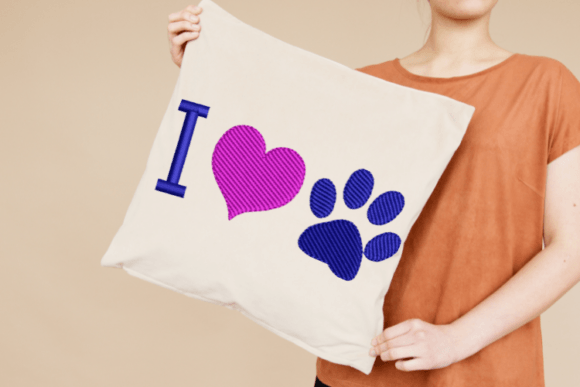
I Love Dogs Embroidery Design
A Designer’s First Look: Playful, Warm, and Immediately Recognizable
When I opened the I Love Dogs Embroidery Design, my first thought wasn’t “cute”—it was “confident.” The script flows with gentle curves and balanced spacing, avoiding the cramped or overly bubbly tendencies that can undermine legibility in machine embroidery. It feels personal but polished—like something a friend would stitch onto a kitchen towel for a dog-loving neighbor, not a mass-produced sticker slapped onto a generic tote. As a designer who regularly sources embroidery files for client projects and small-batch merchandise, I appreciate how this design lands emotionally before it even hits the fabric: warm, sincere, and quietly joyful.
Where It Shines: Real Projects That Feel Thoughtful, Not Trendy
I tested I Love Dogs Embroidery Design on a linen-cotton tea towel—part of a small kitchen-themed gift set for a local pet-friendly café. The result? Instant cohesion. Stitched in soft oatmeal thread on natural fabric, it read clearly at 3.5 inches wide and held up beautifully after two rounds of gentle machine washing. It also worked well scaled down to 2.75 inches on a cotton apron pocket—still legible, still charming, without crowding the curve of the pocket edge.
For craft business owners and Etsy sellers, this design fits seamlessly into several high-intent niches: personalized baby onesies (paired with a tiny paw motif), embroidered patches for dog-walking service uniforms, or as a subtle accent on the hem of a linen pillow cover. I’ve used it on lightweight sweatshirts too—no puckering when paired with medium-weight cutaway stabilizer and a slow-stitch setting. It’s not built for dense applique layers or complex multi-color scenes, but it doesn’t need to be. Its strength is in clarity, warmth, and quiet intention.
Where to Pause: Fabric, Fit, and Functionality
This isn’t a one-size-fits-all embroidery file—and that’s a good thing. I Love Dogs Embroidery Design relies on clean script lines, so it demands attention in specific contexts:
- Thin or stretchy fabrics: On jersey or lightweight knits, the letterforms can blur without proper stabilizer support—always test with tear-away + light cutaway combo.
- Dark or textured backgrounds: The playful script reads best with strong thread-to-fabric contrast. On charcoal towels or bouclé blankets, I switched from ecru to charcoal-gray thread and added a white underlay stitch—small tweak, big impact.
- Curved surfaces: Caps and curved tote handles require careful digitizing adjustments. This design wasn’t optimized for that out of the box—I resized it slightly narrower and reduced density by 8% to avoid distortion on a structured cap front.
- Small hoop sizes: Below 4 inches wide, the descenders on the “g” and “s” start to lose definition. For 3-inch hoops, I recommend confirming the file includes a simplified version—or editing the lower loops yourself if you’re comfortable with embroidery software.
Design Integrity Meets Customer Trust
What makes I Love Dogs Embroidery Design more than just another digital embroidery file is how it supports the perception of your work. When customers see this stitched cleanly on a handmade kitchen towel or baby blanket, they don’t just register “dog lover”—they register care, consistency, and craftsmanship. That matters for boutique branding and Etsy listings where handmade presentation directly affects buyer engagement and repeat sales.
I’ve watched buyers linger longer on product photos featuring this design in natural light, especially when styled with real props—a ceramic mug, a leash coiled beside it, a sunlit windowsill. It invites connection. And because it avoids clichés (no cartoon bones, no exaggerated hearts), it maintains professionalism across contexts: a wedding gift for a couple adopting their first rescue, a staff appreciation item for a veterinary clinic, or a quiet nod on a therapist’s office pillow.
Practical Notes Every Designer Should Run Through
Before stitching I Love Dogs Embroidery Design into your next finished product—or listing it as part of your own craft business assets—here’s what I do every time:
- Test on scrap fabric first, using the exact stabilizer and thread you’ll use in production.
- Check thread color contrast in both daylight and indoor lighting—what looks crisp on screen may fade on dark linen.
- Review stitch density: If the file feels heavy on fill areas (especially in the thicker parts of the “L” and “D”), reduce density by 5–10% for breathable fabrics.
- Confirm hoop size compatibility—this design works best in 4×4 or larger hoops for full fidelity.
- Inspect small details in your embroidery software: are the inner curves smooth? Do any jumps create visible thread nests?
- Test black-and-white mockups to verify readability—this design holds up well, but always double-check.
- Compare light and dark fabric backgrounds side-by-side to choose thread wisely.
- Use proper stabilizer: medium cutaway for knits, tear-away for stable wovens like tea towels and aprons.
- Verify licensing before selling finished items or bundling the file with your own design assets—commercial use rights aren’t assumed.
Final Thought: A Design That Earns Its Place
I Love Dogs Embroidery Design won’t wow with technical complexity—but it doesn’t need to. What it delivers is reliability, emotional resonance, and quiet versatility. It belongs on kitchen towels, baby items, boutique apparel, and heartfelt gifts—not because it’s trendy, but because it feels true. For designers, craft business owners, and makers building real products for real people, that kind of authenticity is harder to find than you’d think. And when it’s stitched cleanly, thoughtfully, and with intention? It becomes more than decoration. It becomes part of someone’s everyday joy.