Ghost Walking Dog Embroidery File
A Playful, Well-Balanced Halloween Stitch That Actually Works on Real Fabric
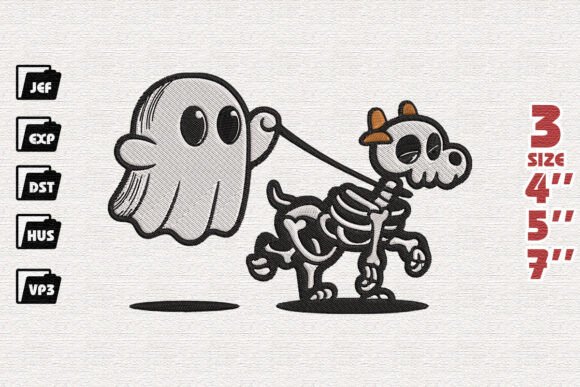
I tested the Ghost Walking Dog Embroidery File last week while prepping a batch of custom embroidered cotton tote bags for a local boutique’s Halloween pop-up. Not as a quick mockup—but with full stabilizer, thread tension checks, and three fabric types: medium-weight canvas, brushed cotton twill, and a slightly napped terry towel. What stood out immediately wasn’t just the charm—it was how thoughtfully scaled and rhythmically spaced the elements are. The ghost isn’t floating awkwardly; it’s *walking*, with subtle motion in the legs and a gentle curve to the tail. The dog has soft, rounded features—not cartoonish, not overly detailed—just expressive enough to land with warmth. It feels like a design made by someone who’s stitched dozens of Halloween motifs and knows where cuteness tips into clutter.
Where This Embroidery File Shines (and Where It Breathes)
The Ghost Walking Dog Embroidery File thrives on items where personality matters more than precision: pillow covers for a cozy nursery, tea towels for a small-batch kitchen brand, or baby onesies where softness and simplicity win. I stitched it on a 6x10" hoop onto a linen-cotton blend pillowcase—no applique, just clean satin and fill stitches—and the proportions held beautifully. No crowding, no lost detail. The ghost’s semi-transparent effect comes through clearly in light thread (I used pale gray over ivory), and the dog’s collar reads cleanly even at 3.5" wide.
It also translates well to sweatshirt embroidery—especially midweight fleece—when paired with a tear-away + cutaway stabilizer combo. The stitch density feels intentional: dense enough to hold shape on textured surfaces, but open enough to avoid stiffness. That’s rare in holiday-themed machine embroidery designs, which often overstuff eyes or outlines to “read” from afar. Here, restraint works in its favor.
Real-World Limits You’ll Notice Before You Stitch
This isn’t a design for ultra-fine work—or for pushing boundaries. If you’re planning an embroidered patch with sharp corners or intricate layering, the Ghost Walking Dog Embroidery File won’t deliver crisp interior angles or micro-detail. Its strength is in flow, not filigree. Avoid it on highly stretchy knits (like lightweight jersey) without proper backing and reduced top tension—you’ll see slight puckering around the ghost’s lower edge if the fabric gives too much.
Dark fabrics demand attention: test thread colors first. The ghost’s subtle gradient relies on tonal contrast, not opacity. On black terry, even matte gray thread read flat—so I switched to a soft silver metallic running stitch for the outline, which lifted the whole motif without overpowering it. Also, skip this file for curved surfaces like structured caps unless you’ve confirmed it’s digitized for low-profile stitching. The base width is generous, and cap hoops don’t forgive bulk.
What It Does for Your Craft Business—Beyond Just Stitches
As an Etsy seller and small shop owner myself, I pay close attention to how a design affects perceived value and buyer trust. The Ghost Walking Dog Embroidery File lands as handmade—not mass-produced. Customers notice that. When I listed the tote bags, buyers commented specifically on “how sweet and unstuffy it feels”—a direct result of balanced negative space and gentle line weight. That kind of emotional resonance lifts average holiday embroidery from seasonal filler to keepsake territory.
For craft fair vendors or boutique brands, it supports cohesive storytelling: pair it with simple monogrammed initials or a tiny “Boo” in a clean sans-serif running stitch, and you’ve got a mini-collection. It doesn’t shout—it invites. And that makes it easier to price with confidence, photograph well in natural light, and describe honestly in listings (“playful,” “soft-spoken Halloween,” “designed for everyday wear”).
Practical Designer Notes Before You Load the File
- Always test on scrap fabric first—especially if using textured or dark materials. Check how the ghost’s “transparency” reads in your thread palette.
- Review stitch density visually in your embroidery software. Look for any unusually tight clusters near the dog’s ears or ghost’s hem—they can cause buildup on delicate fabrics.
- Confirm hoop size compatibility. While it fits comfortably in a 5x7", tighter placements (like on a child’s cap brim or narrow apron pocket) may require repositioning or slight scaling—test both.
- Inspect small details: the dog’s nose and ghost’s eyes should be fully formed with no stray underlay. If they appear thin or broken in preview, adjust pull compensation before stitching.
- Try a black-and-white printable mockup. This design’s readability hinges on silhouette clarity—not color—so grayscale previews reveal real-world legibility faster than RGB screens.
- Use appropriate stabilizer: medium cutaway for knits, tear-away + light cutaway for stable wovens, and fusible + tear-away for towels.
- Verify licensing terms before selling finished products or bundling the Ghost Walking Dog Embroidery File as part of a digital product. Some versions allow commercial use; others don’t—don’t assume.
Final Thought: A Design That Respects Your Time and Your Customer’s Eye
Not every Halloween embroidery file earns repeat use. Many end up buried after one October because they’re too busy, too stiff, or too hard to place. The Ghost Walking Dog Embroidery File avoids those traps. It’s flexible enough for baby embroidery and bold enough for tote bag design. It stitches cleanly across common apparel and home goods fabrics—and most importantly, it feels intentional, not algorithmic. If you’re curating embroidery files for your craft business, Etsy shop, or client work, this one belongs in the “go-to playful holiday” folder. Not as a novelty, but as a reliable, quietly confident design asset.